
You're sitting at the kitchen bench with a quote in front of you. Your builder or window supplier has given you a number for double glazed windows. Then they've offered an upgrade to triple glazing for somewhere between 10 and 20 percent more on the glass. Now you're trying to work out whether the upgrade is worth it.
Here is the honest answer. Triple glazing earns its keep in five specific situations: south-facing rooms with little winter sun, very large glazing areas, cold-climate parts of Victoria, Passive House projects, and homes exposed to road, rail, or flight noise. For most Melbourne homes with reasonable orientation and standard window sizes, a well-specified double glazed system delivers most of the benefit at lower cost. The rest of this article shows you how to tell which side you're on.
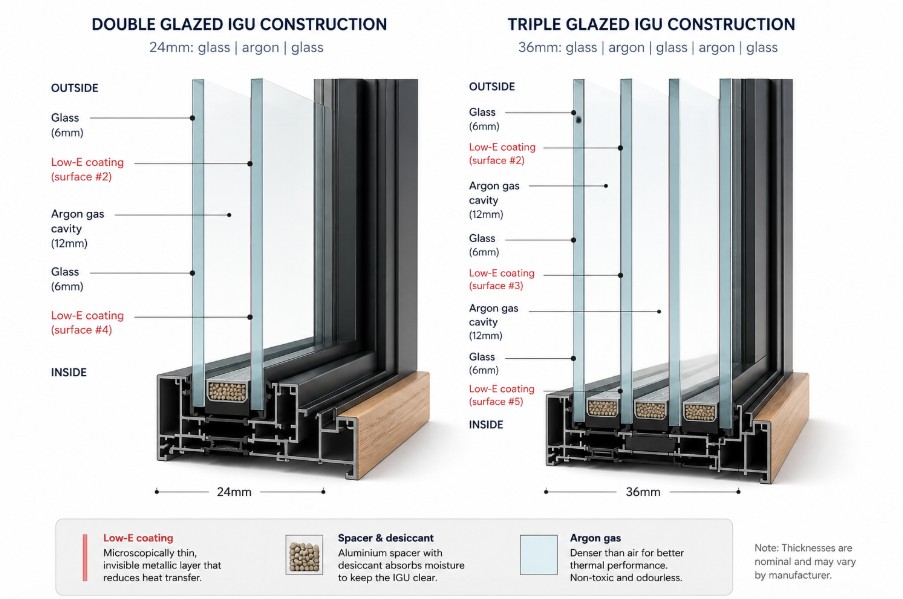
A double glazed window has two panes of glass with one argon-filled cavity between them. Total unit thickness is around 24 millimetres. With a Low-E coating and a multi-chambered uPVC frame, a Weatherall double glazed window achieves a whole-window U-value of around 1.4 W/m²K. That is already four times better than a standard single glazed aluminium window.
A triple glazed window adds a third pane of glass and a second argon-filled cavity. Total unit thickness is around 36 millimetres. The whole-window U-value drops to around 1.0 W/m²K. The improvement is real, but it is smaller than the jump from single to double.
One thing worth understanding: the frame matters as much as the glass. An aluminium frame without a thermal break (a small insulating gap built into the frame profile) conducts cold straight through. Pair that with triple glazing, and the frame undermines the glass spec. A double glazed unit in a multi-chambered uPVC frame can perform better overall. The frame is half the equation, which is why we make our frames in Campbellfield rather than buying them in.
The table below shows whole-window U-values for the three common window types in Australian homes. The third column is the approximate reduction in heat loss compared to a single glazed aluminium baseline.
Configuration | Whole-window U-value | Reduction in heat loss vs single glazed |
|---|---|---|
| Single glazed aluminium | ~5.8 W/m²K | Baseline |
| Double glazed uPVC (Low-E, argon) | ~1.4 W/m²K | ~75% |
| Triple glazed uPVC (Low-E, argon) | ~1.0 W/m²K | ~83% |
Most of the gain happens at the jump from single to double. Triple glazing captures the remaining 8 to 10 percentage points. That is the diminishing-returns picture in one row of numbers, and it is the reason triple glazing is the right call for some homes and a poor use of money for others.
Triple glazing in Melbourne earns its premium in five specific situations.
A wide stacker door asks a lot of the structure above it. The wider the span, the more load the lintel has to carry, and the tighter the tolerance for deflection.
For spans up to 3 metres, a standard timber or engineered lintel is usually sufficient, sized by your builder or architect. Over 3 metres you're generally looking at steel, either a single beam or a combined timber-and-steel member. Over 4 metres, engineering input is typically required to specify the beam and the support at each end. [VERIFY WITH CLIENT: the span threshold at which Weatherall recommends structural engineering sign-off.]
Two things matter as much as the beam itself:
Bring your plans to your door manufacturer before the lintel is specified, not after. The door spec influences the structural requirement, and agreeing them together is far easier than retrofitting.
Triple glazing has costs that are not on the quote sheet.
The third pane reduces visible light transmission slightly. In rooms where natural light is already limited, a triple glazed window can read as marginally darker than its double glazed equivalent. For most rooms, the difference is imperceptible. For a south-facing study with one small window, it is worth noting.
Triple glazed units are roughly 50% heavier than equivalent double glazed units. That means more robust hardware, more careful installation, and sometimes a structural sign-off for very large openings. Those costs sit on top of the glass premium.
Solar Heat Gain Coefficient (SHGC) drops with the third pane. SHGC measures how much free solar warmth comes through the glass. For Melbourne, a north-facing window contributing passive solar gain in June and July is useful free heating from the sun. The third pane reduces that gain. On north-facing rooms in particular, the U-value improvement and the SHGC reduction partly cancel each other out.
The price premium of "10 to 20% on the glass" is the headline number. Then add the heavier hardware, the more careful installation, and any structural work for very large openings. The total project premium can run higher than the headline figure. Get the full quote rather than just the glass quote.
When you are choosing between double and triple glazing, five questions separate a useful manufacturer conversation from a sales pitch.
We make Weatherall windows in Campbellfield, and triple glazing is available across the range. That means a consultation can spec triple glazing where it earns its keep and stay on double glazing where it does not. It is a different conversation than the one a reseller can have, because we control both halves of the answer.
The cheapest moment to upgrade from double to triple glazing is in the order, before the windows are manufactured. The cost of adding the third pane to a unit that has not yet been built is the price of the additional glass and gas. Changing your mind after the windows are in the wall is far more expensive: new windows, new installation, and the disruption of pulling out and replacing what is already there.
If you are at the design stage now, this is the moment to decide. Bring the floor plan into a Weatherall showroom and walk through it room by room. Some rooms will benefit from triple glazing. Most will be well served by double. A quality consultation will tell you which is which, in writing, on the same page as the quote.
