
You have two quotes on the table. One for double glazed aluminium windows. One for double glazed uPVC. The aluminium quote is lower. The decision feels straightforward until you realise the install price is the smallest number you will spend on these windows over the time you own the house.
Windows last 30 years or more if they are decent. The frame material decides what happens during those 30 years: how much you pay to heat and cool the house, how much maintenance the frames need, how often a section needs touching up, and how warm the room feels in July. None of that shows up on a quote. All of it hits your bank account.
This article walks through the 30-year cost picture for a typical Melbourne home, with worked numbers on each component. By the end you will know which question to ask the next time an installer hands you two quotes, and what answer you should expect.
Industry pricing for residential uPVC and aluminium windows in Melbourne sits in two ranges that overlap more than most homeowners expect. uPVC typically runs $600 to $1,100 per square metre supplied and installed. Standard aluminium runs $500 to $800. Premium thermally broken aluminium with double glazing climbs into the uPVC range and can exceed it for high-spec architectural systems.
Most installers quote per window rather than per square metre, because each opening is a different size and configuration. A typical replacement window comes in at $2,200 to $3,500 fully fitted for uPVC double glazed, and $1,500 to $2,500 for standard aluminium double glazed.
For a three-bedroom Melbourne home with 10 to 15 windows, the whole-of-home spread is roughly $15,000 to $40,000 for uPVC and $12,000 to $32,000 for aluminium. The uPVC premium sits between 20 and 30 percent on most projects.
The gap is real. The gap is also not the only number that matters.
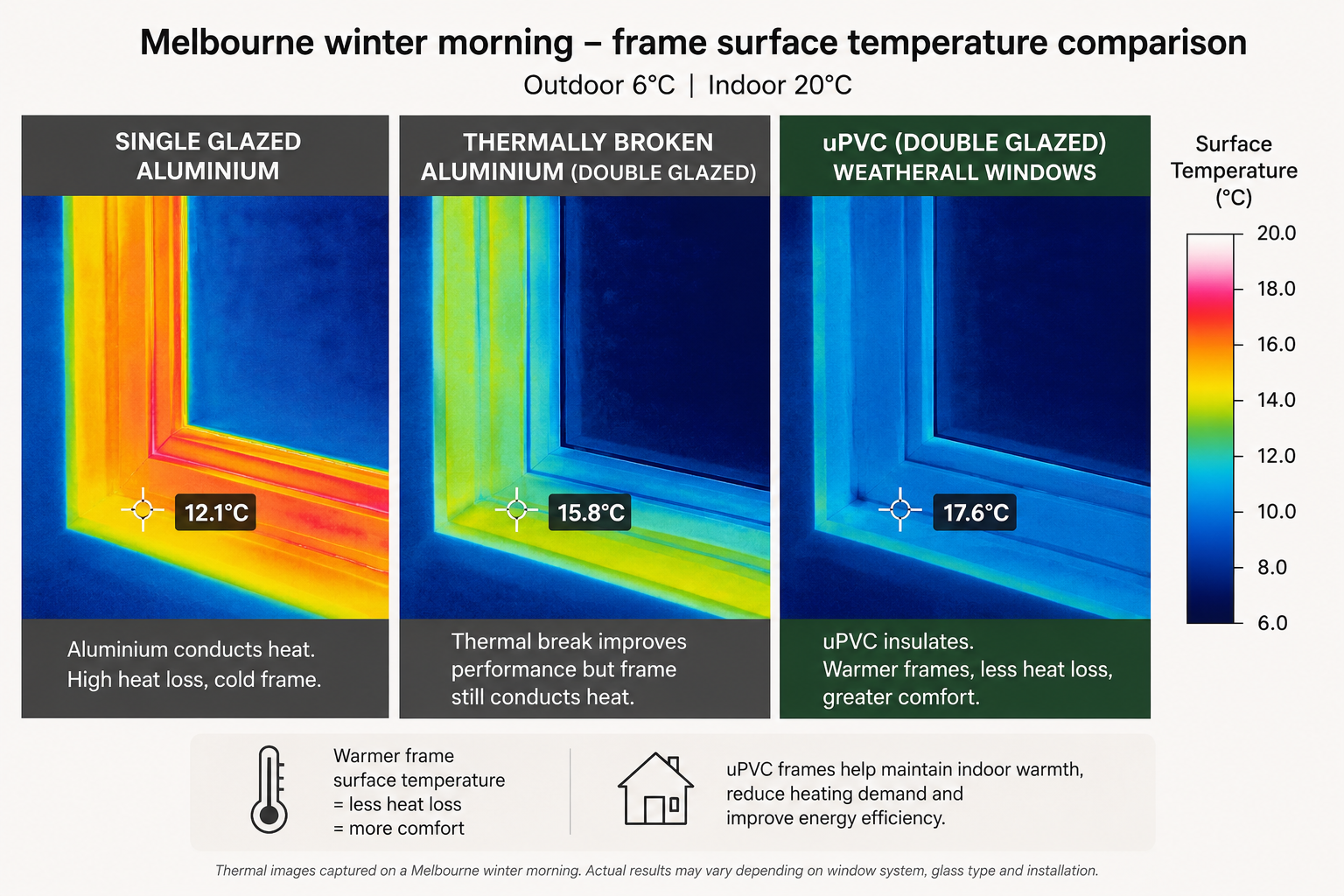
A window’s U-value tells you how fast heat moves through it. The lower the number, the slower the heat loss. Government data is clear about why this matters: up to 40 percent of a home’s heating energy is lost through windows in winter, and up to 87 percent of the heat that builds up inside on a summer day comes through them. Those figures come from yourhome.gov.au, the Australian Government’s residential design guide, which is the source most energy assessors and the National Construction Code rely on.
Frame material drives most of that performance. Standard aluminium has a frame U-value between 4.5 and 7.0 W/m²K. It conducts heat hundreds of times faster than uPVC. Thermally broken aluminium, which inserts a non-metal barrier inside the profile, brings that down to roughly 2.5 to 4.0. uPVC double glazed windows from a quality manufacturer reach a whole-window U-value as low as 1.4 W/m²K, which is what Weatherall’s standard double glazed uPVC windows achieve with Low-E glass and an argon-filled cavity.
That 1.4 figure is the central number in the value case. Here is what it looks like in practice.
What 1.4 vs 6.2 W/m²K means on a Melbourne winter night (10°C outside, 20°C inside, 25 m² of glazing):
In summer, the same physics works in reverse. Aluminium frames absorb the sun and pump heat into the house through the metal. uPVC frames stop that conduction at the surface. For a typical 200 m² Melbourne home with around 25 m² of glazing, the energy differential between modern uPVC double glazing and the single glazed aluminium most renovators are replacing runs to several hundred dollars a year on heating and cooling combined. A fair Melbourne range for that comparison is $300 to $600 a year. Methodology and assumptions are in the writer’s notes for transparency.
The maintenance picture is where the upfront price gap starts to close.
Aluminium frames are powder coated with a polyester finish that protects the metal underneath. Reputable manufacturers offer 10 to 25-year warranties on the powder coat. The coating itself does not need repainting in normal residential conditions. What it does need watching is the joints, where corrosion can start under the coating after 15 to 20 years. The risk climbs sharply for coastal-exposed Melbourne homes near Port Phillip Bay or in bayside suburbs like Brighton and Sandringham. Repair work on a corroded joint or partial frame recoat runs $300 to $800 per window when it is needed.
uPVC needs washing. That is the maintenance cycle. Quality uPVC frames do not rust, rot, peel, or need painting. The colour is part of the material rather than a coating, so chips and scratches do not expose anything underneath. Modern UV-stabilised uPVC profiles built for Australian conditions resist fading and brittleness in a way that earlier generations of the material did not.
Across a 30-year ownership window, the maintenance differential adds up to $1,000 to $3,000 in favour of uPVC for a typical Melbourne home, and more than that for coastal addresses where aluminium corrosion starts earlier.
Both materials outlast a 30-year ownership window when the install is done well. Quality aluminium with proper powder coating runs 30 to 45 years before structural replacement is on the cards. Modern German-engineered uPVC profiles, the kind used in Australian-manufactured systems built for our UV load, typically run 30 to 40 years. The frame lifespan gap is smaller than older aluminium-industry marketing material suggests.
The insulated glass units inside the frames have a separate failure mode. Seal failure leads to fogging or condensation between the panes, and is independent of the frame material. Quality IGUs run 20 to 25 years before any seal failure shows up. Unit replacement runs $400 to $900 per window if it is needed.
What matters more than the headline lifespan number is who stands behind the product. Weatherall manufactures every uPVC frame, sash, and door at the Campbellfield factory north of Melbourne, and backs the products with a 10-year guarantee. The warranty is direct from the maker rather than passed through a reseller, which matters when something goes wrong. Imported aluminium and uPVC systems can have warranty periods that look comparable on paper, but the service path runs through a distributor relying on a supplier on the other side of the world to authorise repairs. Lead times on warranty work can stretch from weeks to months as a result.
Here is how the numbers add up for a three-bedroom Melbourne home with around 25 m² of glazing across 12 windows. The comparison is between a like-for-like double glazed aluminium and double glazed uPVC package, both modern systems suitable for new builds and renovations. Figures are inclusive of install.
| Cost component | Modern aluminium double glazed | uPVC double glazed (Weatherall) |
|---|---|---|
| Year 1: supplied and installed | $15,000 to $20,000 | $20,000 to $28,000 |
| Maintenance, years 1 to 30 | $1,500 to $3,000 | $0 to $300 |
| Heating and cooling differential, years 1 to 30 | $4,500 to $9,000 additional | Baseline |
| IGU seal failure repair (typical) | $1,000 to $2,000 | $1,000 to $2,000 |
| 30-year total cost of ownership | $22,000 to $34,000 | $21,000 to $30,300 |
Two things to notice in the table. First, the headline upfront price gap (around $5,000 to $8,000 in the aluminium’s favour) gets eaten by the energy differential well inside the first 15 years for most Melbourne homes. Second, the comparison shifts more dramatically against single-glazed aluminium, which is what most renovators are removing rather than modern double glazed aluminium. The energy differential against single glazed alone runs $9,000 to $18,000 over 30 years, before any maintenance figure is added. The price gap inverts inside the first decade.
uPVC is the better answer for most Melbourne homes most of the time. It is not the right answer for every project. Aluminium is the right call in three specific situations.
The install price is the easiest number for any window company to give you. The 30-year picture takes more work to put together, which is why most quotes do not include it. Ask for both. A reputable installer should be able to walk you through the whole-window U-value, the heating and cooling savings against your specific home’s glazing area, and the warranty terms beyond the install year. If they cannot, that is information by itself.
Weatherall manufactures every uPVC frame, sash, and door at the Campbellfield factory and provides a 10-year guarantee on the products that come out of it. To request a quote that includes the 30-year energy figure alongside the install price, contact the showroom or book a consultation through the website.
