
Every door quote uses the word secure. Very few of them say what sliding door security is made of.
Four things decide how hard a sliding door is to force open. How many points the lock engages. How far the panel can lift inside its frame. How deeply the panels hook into each other where they meet. And what the glass is made of. A door with one catch and a loose panel is the easy case. Multi-point locking, anti-lift hardware and laminated glass each make forced entry harder, slower and louder. None of them make it impossible.
Read on with your own back door in view.
A sliding door has three weak points, and only one of them is the lock. The panel can be lifted clear of its track. The catch can be worked at its single point. And the glass can be broken.
Start with the lift. A sliding panel rides on small rollers in a bottom track. It needs clearance above it to go into the frame, and that gap is the weakness. Say the gap is generous, or the rollers have dropped over the years. The panel can then be raised clear of the bottom track with the catch still engaged. The lock stops mattering once the panel is out of the frame. Doric, an Australian door hardware maker, names the two attacks a sliding lock must answer: lifting the panel out, and levering it open.
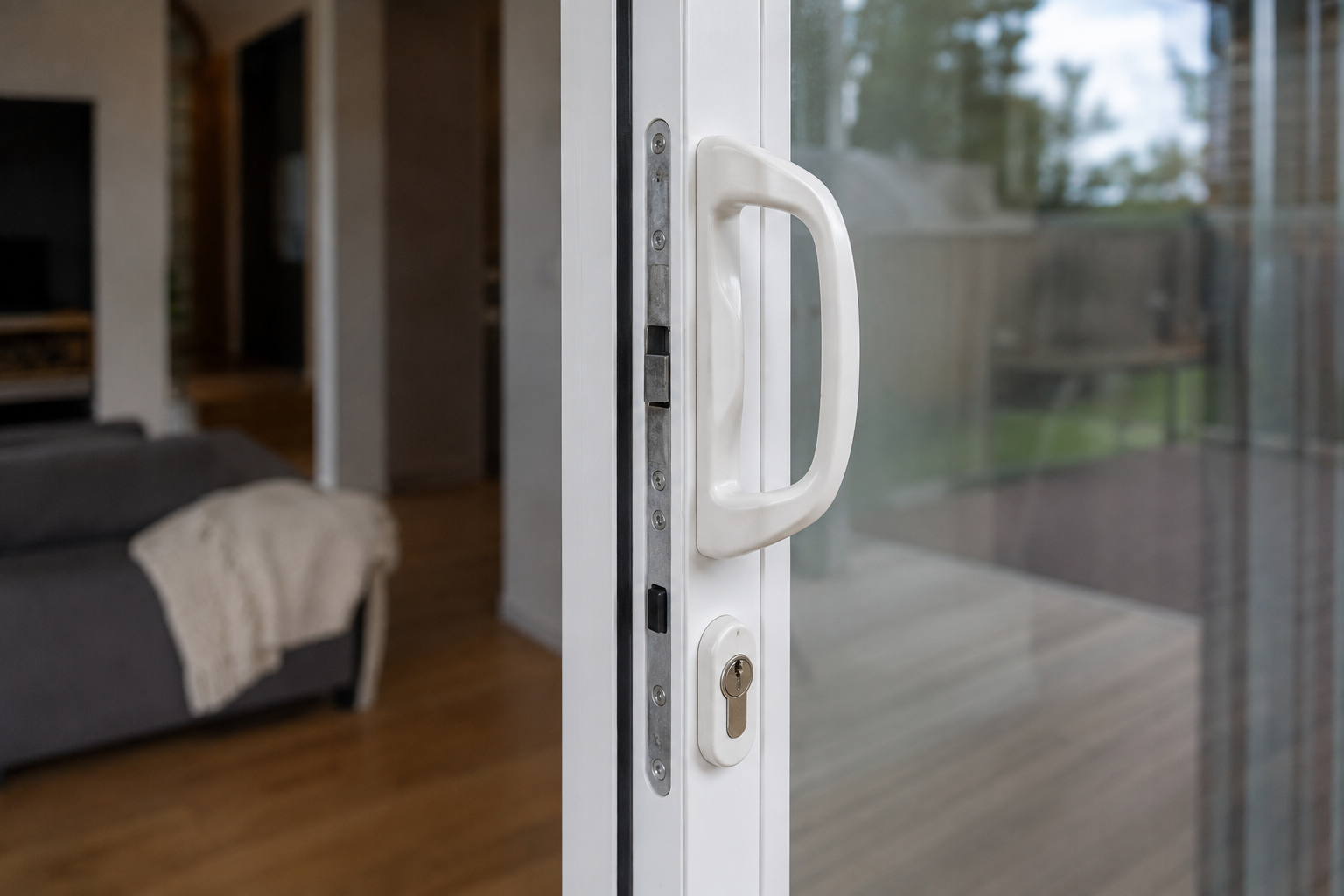
Then the catch itself. Most standard sliding doors lock at one point, about halfway up the leading edge. Everything applied to that door concentrates there, on one catch and the frame behind its plate. A door you have to shove or lift before it will latch is telling you the two no longer meet squarely.
The third point is the interlock, where the sliding panel meets the fixed panel or the jamb. The two profiles hook into one another. A shallow interlock lets the panels be pulled apart far enough to reach the catch. A deep one holds them together.
Keep this in proportion. The Australian Bureau of Statistics Crime Victimisation survey for 2024-25 found 1.8% of Australian households experienced a break-in. That is down from 2.7% ten years earlier. The same survey's pooled figure for Victoria to June 2025 was 1.9% of households, around 51,700 a year. Where an attempt failed, the most common evidence households reported was a damaged or tampered door or window, at 40%. Doors and windows are where the pressure lands.
| Where the weakness sits | What it looks like on your own door | What changes it |
|---|---|---|
| Vertical play at the head | Push up on the closed panel and it rises more than a few millimetres | Anti-lift blocks in the head track, roller adjustment, or a lift and slide mechanism |
| A single locking point | One catch, roughly halfway up the leading edge, worked by one handle | Multi-point hardware engaging along the height of the panel |
| A shallow interlock | The closed panels rattle against each other when the door is pushed | A deeper interlock profile, which is a function of the door system |
| The glass | A single sheet, or a sealed unit with no laminated pane in it | Laminated glass specified as one pane of the double glazed unit |
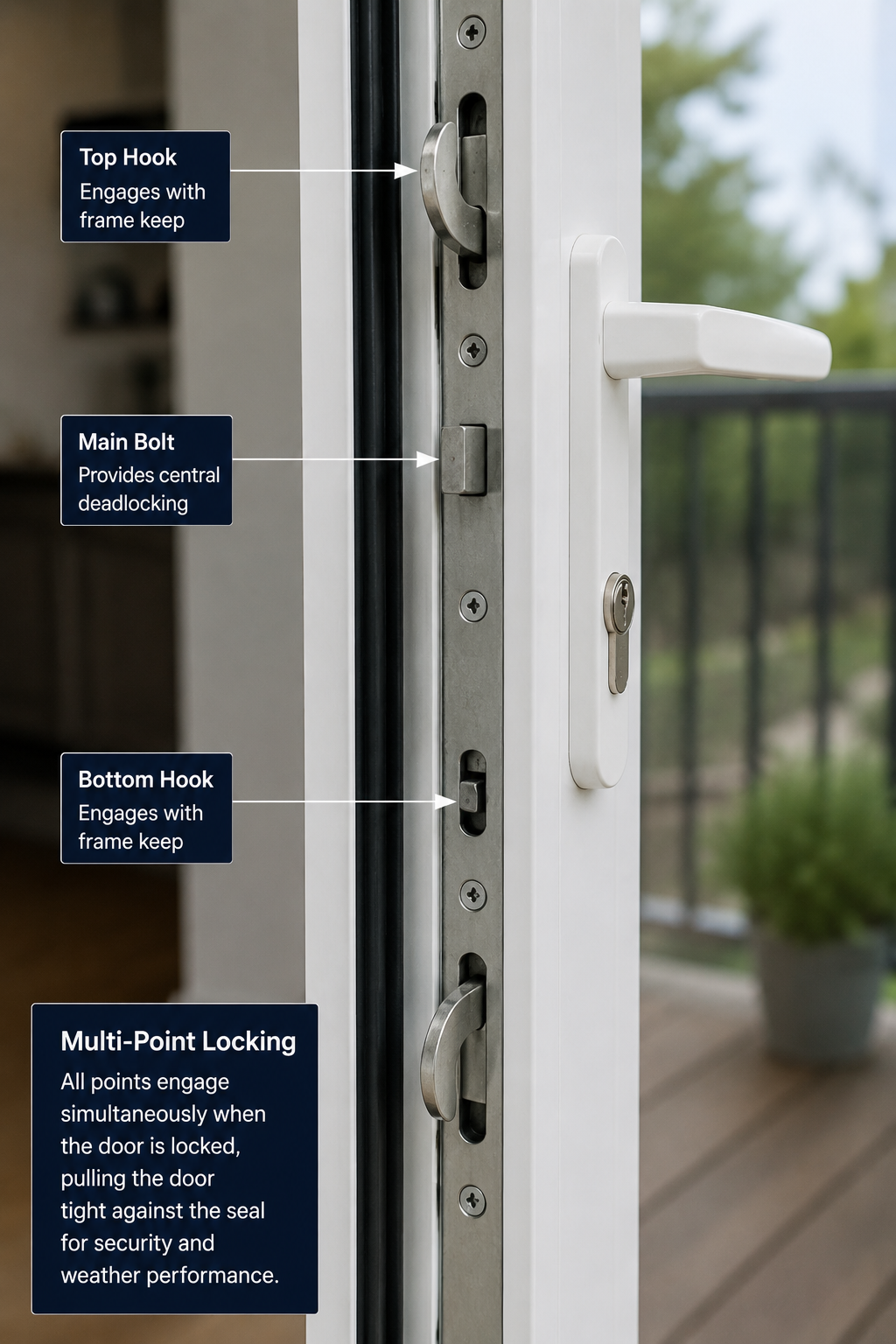
A multi-point lock engages the door into its frame at several places at once, from a single handle or key turn. On a sliding door those points are usually hooks. They swing out of the leading edge of the panel and pull into plates set in the jamb.
The mechanism matters more than the number of points. The hooks draw the panel in towards the frame as they engage. Force applied anywhere along the door is then shared across every engaged point and the fixings behind it. The same action squeezes the seals, which is why a multi-point door feels heavier to close and draughts less once shut.
There is a limit worth stating plainly. Locking hardware makes forced entry harder, slower and noisier. Nothing about it prevents a break-in. A multi-point lock on a panel that still lifts is a good lock with an open path around it.
The door system is a better guide than the frame material. uPVC systems, built from the rigid plastic used in most modern frames, are usually designed around multi-point gear. The hardware and the frame profile get drawn together. Single-catch hardware turns up more often at the budget end of any material. Ask which one you are being quoted, because both get sold as secure. [VERIFY WITH CLIENT]
Lift and slide doors deal with the vertical play by design. The handle lifts the panel off its seals to move it, then lowers it back onto them to close. Shut, the panel's weight sits into the frame and the head clearance is gone. The mechanism exists for sealing and easy movement on heavy panels, and the lift resistance comes with it.
Two rollers carry the whole panel, every day, for the life of the door. Double the glass and you double what they carry.
Double glazing is two panes of glass with a sealed gap between them. It is a thermal and acoustic specification. Reading it as a security specification is the most common mistake buyers make here.
Two panes do take more work than one, and a sealed unit is stiffer than a single sheet. It rarely goes through in one blow, which buys seconds.
Which glass sits in the unit is what changes the answer. Toughened glass is heat-treated. It fails into small blunt fragments and the whole pane clears the opening at once. Laminated glass is two sheets bonded to a plastic interlayer, usually polyvinyl butyral. When it breaks, the pieces stay stuck to that interlayer and the sheet stays in the frame.
This matters at quote stage because the standard leaves the choice open. AS 1288 is the Australian standard for selecting and installing glass in buildings. It calls for Grade A safety glass in a door and in glazing close to one. Toughened meets that. So does laminated. A fully compliant door can be built either way, and the two behave nothing alike when something hits them.
Laminated glass can be specified as one pane of a double glazed unit, usually the outer one. Thermal performance stays where it was and only the failure behaviour changes. It also cuts more low-frequency noise, so on a road-facing elevation it is often already on the quote. It resists penetration without being unbreakable. What it removes is the fast way through, the single hit that empties the opening.
A restrictor limits how far a sash can open. A key-locking handle stops the sash opening without the key. They do different jobs, and one of them was never a security job.
Restrictors on upper-storey bedrooms exist to stop children falling. Clause 11.3.7 of the ABCB Housing Provisions sets the rule. It applies to a bedroom window where the floor below sits 2 m or more above the surface beneath. It applies where the lowest part of the opening is under 1.7 m above the floor. The device has to stop a 125 mm sphere passing through, or resist an outward force of 250 N. If your builder has put restrictors upstairs, that is the rule being met.
Key-locking handles are the security item, and they carry a real trade-off. Fire Rescue Victoria and the CFA both advise two ways out of every room. Both also advise keeping keys in deadlocks whenever anyone is home. A window nobody can open without hunting for a key is a window nobody can climb out of. Fit them if you want them, and keep the key at the window.
Ground-floor bedrooms pinch hardest here. The window has to be openable overnight and secure at the same time. Inward-opening window types answer that with a ventilation position that keeps the sash locked into the frame.
Most of these cost less than a service call.
On a Melbourne rear extension the sliding door usually lands on the least visible side of the house, facing a back fence or a rear laneway. That is the door worth checking first. It is commonly the one that gets adjusted last.
None of this asks you to buy anything. Do it before you price a replacement. It tells you whether you have a poor door or a neglected one.
Start with the panel rather than the lock. Close the door and push up on it. If it lifts more than a few millimetres, anti-lift blocks in the head track and a roller adjustment close that gap cheaply. After that, add a second locking point away from the original catch. Glass comes last, because changing it usually means changing the sealed unit.
Yes. Any door can be forced given enough time and noise, and no hardware or glass changes that. What good hardware changes is how long it takes and how much attention it draws. A door with one catch, a loose panel and a single sheet of toughened glass gives up quickly.
It depends on the opening. On a ground-floor door or window facing a fence, a laneway or a side path, it is the one change that alters what happens when the glass breaks. The sheet stays in the frame. On an upper-storey window it earns its place more for noise than for security. It is specified as one pane of the sealed unit, so it costs less at order stage than as a later change.
Look at the hardware rather than the frame material. What decides it is the gear the system was designed around, and both materials come with single-catch and with multi-point options. uPVC systems tend to carry multi-point hardware as standard, because the locking gear and the frame profile are engineered together. Ask any supplier how many points their door engages and where, then compare those answers.
It is a lock that engages the door into its frame at several places at once, from one handle or key turn. On a sliding door the points are usually hooks along the leading edge that pull into plates in the jamb. On a hinged or tilt and turn unit they are bolts that throw around the perimeter of the sash. The design spreads force across several engagements.
The locking specification almost never gets itemised on a door quote. Glass make-up gets a line. Frame colour gets a line. Hardware gets the word secure. That is where a cheaper system saves money, because the difference stays hidden until the door is in.
Ask for two things in writing before you sign. How many points the lock engages, and where they sit on the panel. And the glass make-up pane by pane, including whether either pane is laminated. Both are settled before manufacture and cost far more to change later. Weatherall Windows can put both on the quote for you.
