
If you've been looking at windows for a Melbourne home, you've probably seen a small number on every spec sheet: 1.4, 2.8, 3.5, 6.0. Manufacturers rarely explain what it means. They should.
That number is the U-value, and it predicts what your windows will cost you in heating bills over the next twenty years better than almost anything else on the quote. This article walks through what it measures, the range you'll see across different window types, and what a low U-value is worth in dollars for a typical Melbourne home.
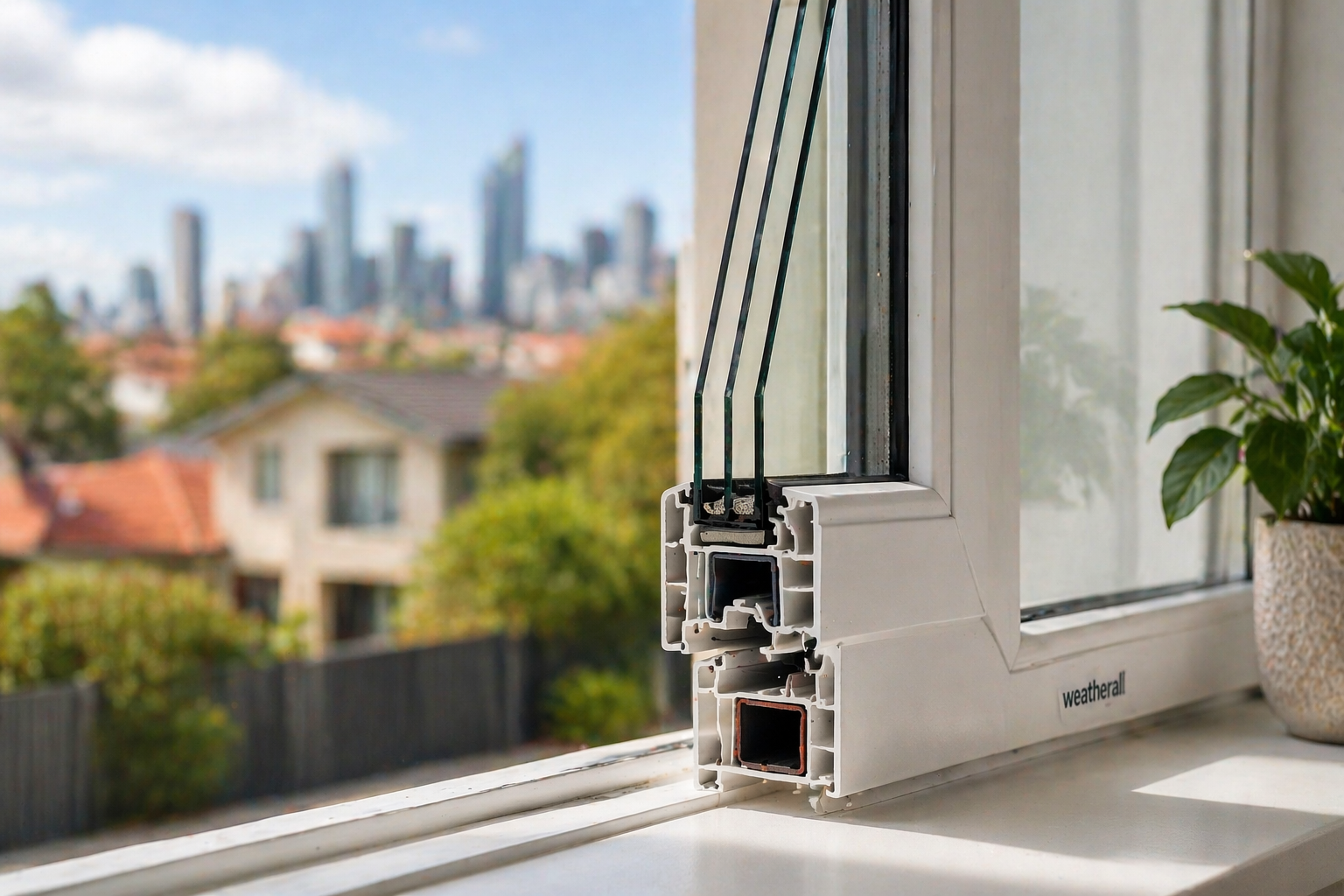
A U-value measures how quickly heat transfers through a building element. For a window, it describes how fast warmth escapes through the glass and frame when it's colder outside than in. The unit is W/m²K, which reads as watts per square metre per degree Kelvin of temperature difference.
The translation matters more than the formula. If it's ten degrees warmer inside your home than outside, a window with a U-value of 2.0 loses 20 watts of heat per square metre. At U-1.0, it loses 10 watts. At U-6.0, it loses 60 watts per square metre the whole time your heating is running.
Lower number, better insulation. That's the entire rule.
Here's the range you'll run into when comparing windows in Melbourne:
Weatherall's standard double-glazed uPVC with Low-E glass and argon fill achieves a whole-window U-value as low as 1.4 W/m²K. That's more than four times more insulating than the single-glazed aluminium still fitted to most older Melbourne homes.
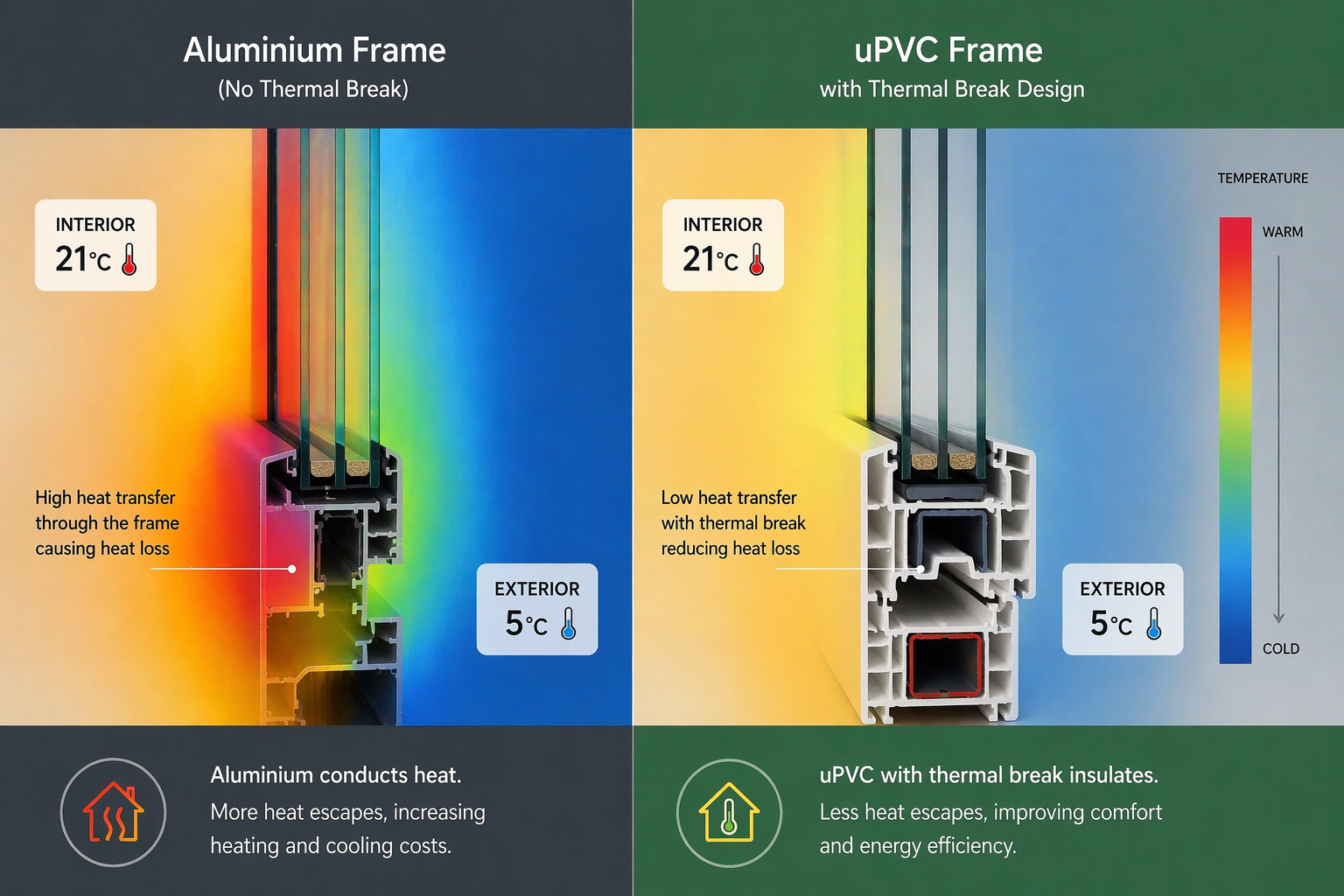
The number a manufacturer quotes should be the whole-window U-value, which blends the glass performance with the frame performance. A lot of quotes only list the glass U-value. That's misleading. A window is a system, and the frame makes up between a third and half of it.
This is where aluminium windows struggle. Aluminium conducts heat around a thousand times faster than uPVC. Even with high-performance double glazing, an aluminium frame pulls the whole-window number up because the frame itself is a highway for heat to escape. You can feel it with your hand in winter: an aluminium frame sits close to outdoor temperature, while a uPVC frame stays close to room temperature.
A thermal break is a strip of non-conductive material inserted into an aluminium frame to interrupt that heat path. It helps. It also pushes the price up, and a plug in a leak is still a plug in a leak. uPVC is a thermal break by design. The material itself barely conducts heat, so the whole frame performs.
The practical result: two windows using identical glass can land at very different whole-window U-values depending on the frame. A double-glazed aluminium window without a thermal break might sit at U-4.5. The same glass in a uPVC frame can reach U-1.6. Same glass. Very different outcome for the room behind it.
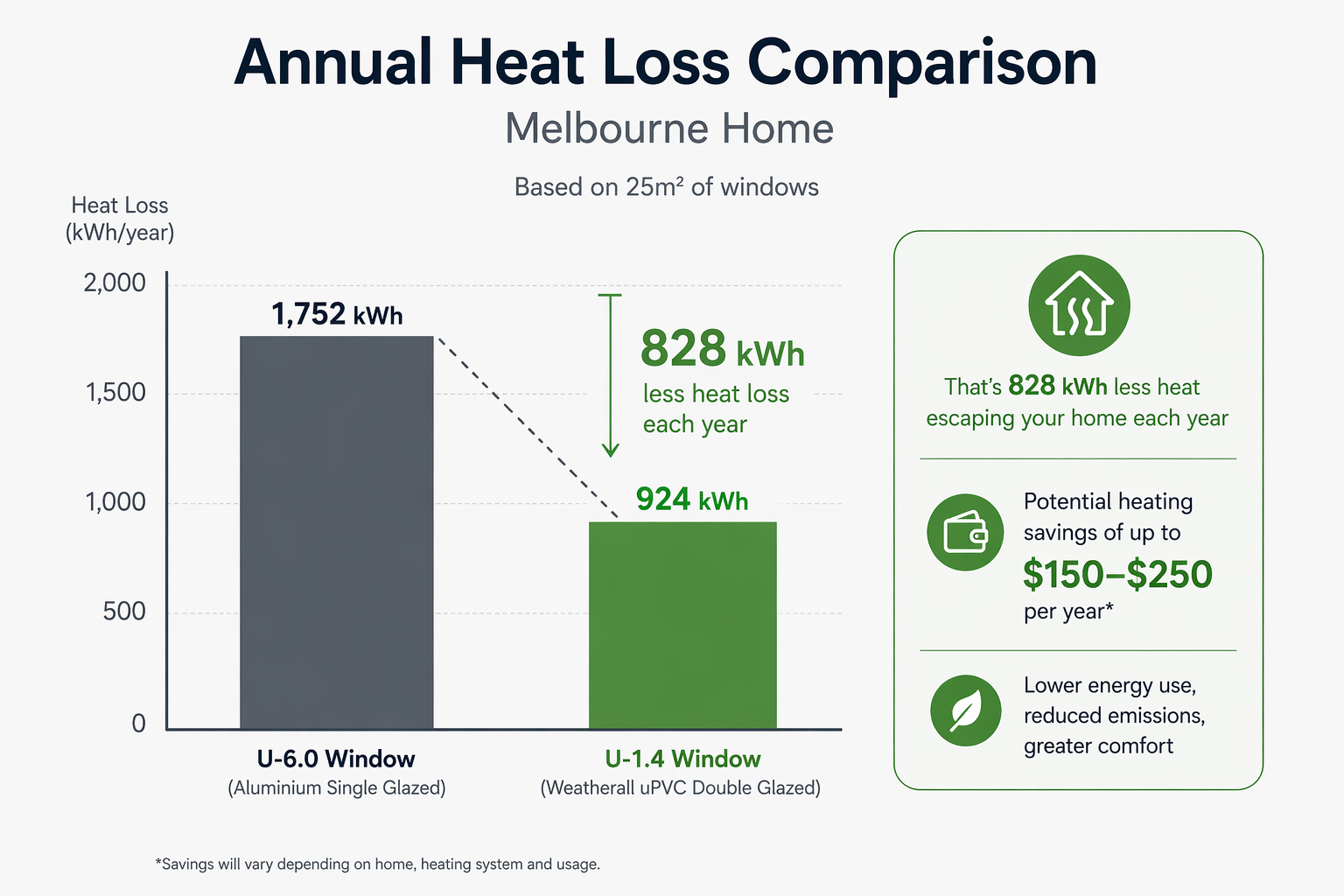
A worked example. A 150m² single-storey Melbourne home with 25m² of west-facing windows. One version has single-glazed aluminium at U-value 6.0. The other has Weatherall uPVC with Low-E and argon at U-value 1.4. Every other variable is identical.
The heat-loss calculation is straightforward: heat loss in watts equals U-value multiplied by window area multiplied by the indoor-outdoor temperature difference. Using a 10°C average differential across Melbourne's heating season:
With heating running around six hours a day across a 120-day Melbourne winter, the single-glazed home loses roughly 1,080 kWh of heat through those windows each year. The uPVC double-glazed home loses about 252 kWh. The 828 kWh difference is what the heater has to make up.
At current Victorian energy prices, replacing that 828 kWh of lost heat costs somewhere between $100 and $200 per winter, depending on whether the household runs gas ducted heating or a reverse-cycle split system. Over twenty years, and factoring in the gas price rises Victorian households have seen since 2022, the compounded cost sits in the low-to-mid thousands. From the windows alone.
One honest caveat. Windows are one factor in the whole-of-house thermal picture: insulation, draught-proofing, and orientation all matter. But windows are the biggest single lever a renovator can pull. Australian Government YourHome data shows up to 40 per cent of a home's winter heat loss and up to 87 per cent of its summer heat gain travels through the glass.
Since 1 May 2024, new Victorian homes must hit a minimum 7-star NatHERS rating under the National Construction Code 2022, along with a separate Whole-of-Home energy score of at least 60 out of 100. Window U-value is one of the heaviest inputs into that thermal assessment. A home that might have scraped six stars with double-glazed aluminium won't necessarily reach seven with the same glass in an aluminium frame.
The practical implication: if your builder is still quoting aluminium frames, either they're behind on the new rules or the design will need heavier compensation elsewhere (more wall insulation, smaller window areas, tighter air-sealing) to hit the rating. We've covered the 7-star rule in full detail in a separate article.
A manufacturer who knows their product will publish all three of these. A reseller or importer sometimes can't, because the data depends on tested system performance and some quote-writers simply don't have it. Asking for these three numbers will separate the two groups faster than any sales pitch.
Whole-window U-value. Confirm it's the whole-window number and not the glass-only figure. The glass number looks better than the real-world performance, and some quotes show it without saying so.
SHGC (Solar Heat Gain Coefficient). A number between 0 and 1 describing how much radiant solar heat the window lets through. Low SHGC keeps summer heat out. High SHGC lets winter sun in. Which one you want depends on the orientation of each window. Your west-facing windows should run a lower SHGC than your north-facing ones.
Air infiltration rate. This measures how airtight the window is when closed. A window can have a good U-value and still leak air around the seals, which undoes the real-world performance. Look for the certified air infiltration result from the WERS test, not a marketing claim.
If a quote lists only the glass U-value and won't give you the whole-window number when asked, that tells you how much confidence the supplier has in their product. Weatherall publishes whole-window U-value, SHGC, and air infiltration data for every frame made at our Campbellfield facility. You can pull the numbers straight off the product pages, or bring a quote from another supplier into the showroom and we'll walk through it with you.
